

News
22 April 2026 |News
ILO assessment examines the state of social dialogue and collective bargaining in Montenegro
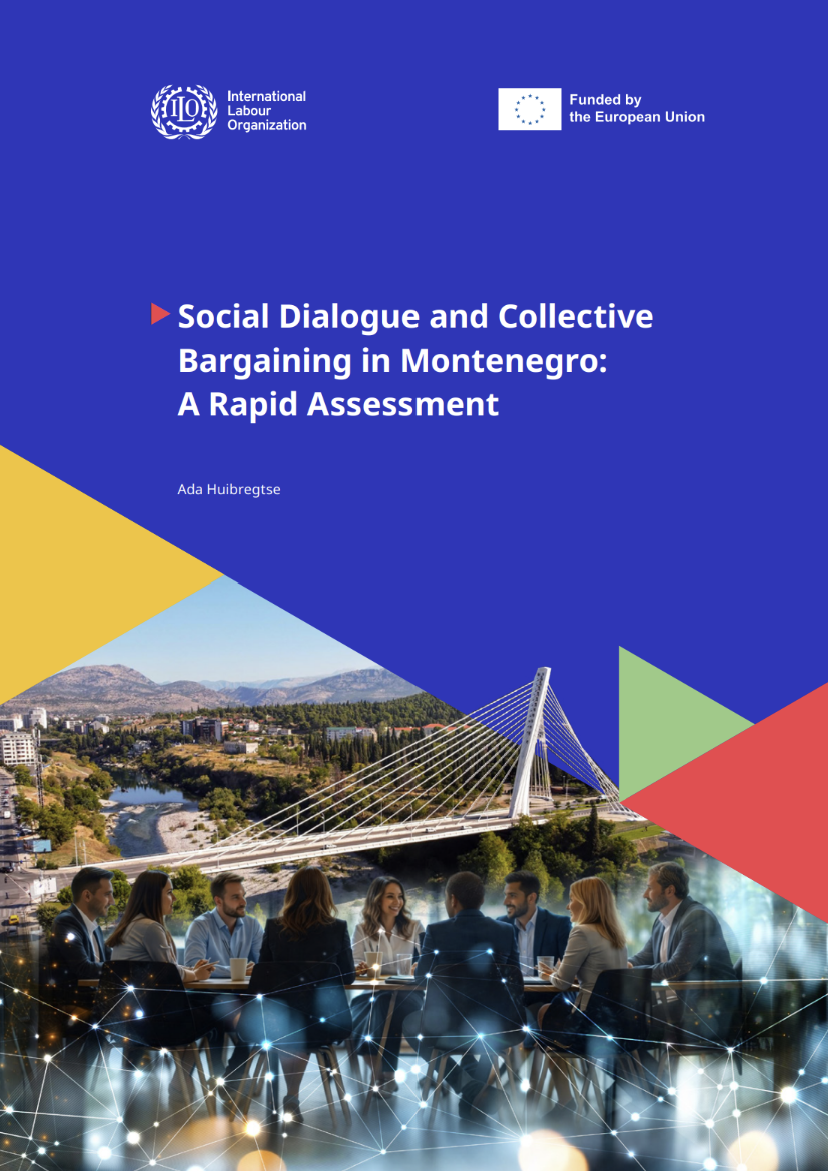
©ILO Social Dialogue and Collective Bargaining in Montenegro - A Rapid Assessment
The International Labour Organization (ILO), through the European Union-funded Employment and Social Affairs Platform 3 (ESAP 3), has published a new assessment titled Social Dialogue and Collective Bargaining in Montenegro: A Rapid Assessment. The publication reviews the legal, institutional and practical functioning of social dialogue and collective bargaining in Montenegro, with a view to informing stakeholders and supporting reforms in line with international labour standards and the EU acquis, including in the context of Chapter 19 on social policy and employment. This publication is intended as an analytical stocktaking exercise and a practical contribution to future policy development and stakeholder engagement in Montenegro.
The assessment finds that Montenegro has a comparatively well-developed legal and institutional framework for social dialogue, with established tripartite structures and formal mechanisms for consultation. At the same time, it highlights an important implementation gap: while the Social Council appears to function relatively well internally, its opinions and recommendations are often not reflected in final legislation or policy decisions, especially once proposals move to higher levels of government or Parliament.
The publication also shows that collective bargaining in Montenegro is stronger in law than in practice. Collective bargaining is more institutionalized and outcome-oriented in parts of the public sector, where agreements have delivered tangible improvements in wages and working conditions. In contrast, bargaining remains weaker and more fragmented in much of the private sector, particularly among micro, small and medium-sized enterprises. The assessment further underlines that capacity constraints affecting both institutions and social partners limit the depth, continuity and policy impact of dialogue.
Beyond identifying current strengths and challenges, the assessment points to the need to strengthen the connection between dialogue and decision-making, improve follow-up to Social Council recommendations, and expand the role of social dialogue and collective bargaining in addressing emerging labour market issues such as digitalization, labour shortages, skills transitions and the green transition.