


News
30 April 2026 |News
RCC ESAP 3: May Day in the Age of AI: Progress Must Be People-centred
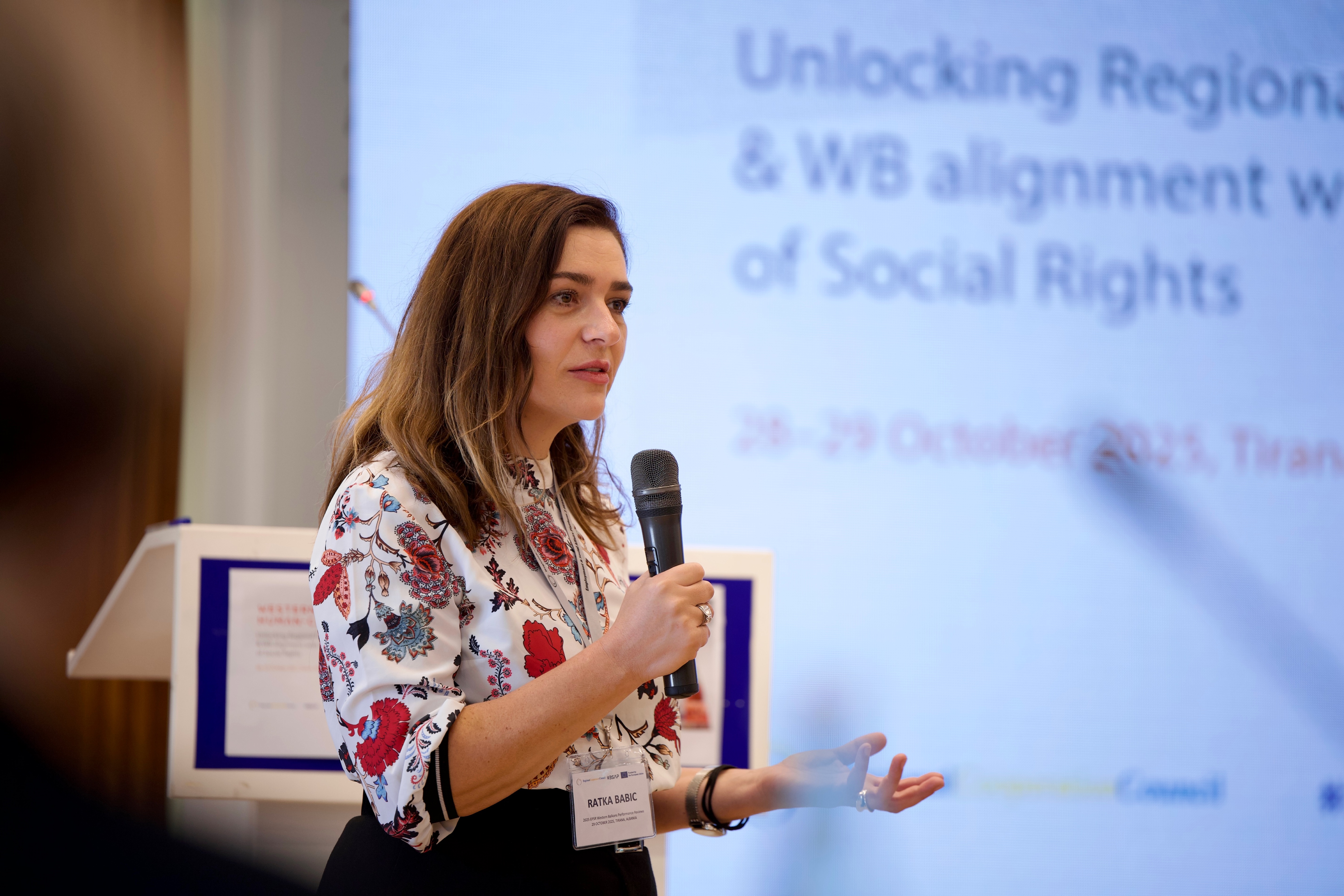
RCC ESAP 3 Team Leader Ratka Babic adressing the audience (Photo: RCC ESAP 3/Henri Koçi)
Op-ed on the occasion of 1 May Labour Day by Ratka Babic, Team Leader of ESAP: Employment and Social Affairs Platform 3, joint project by Regional Cooperation Council (RCC) and International Labour Organisation (ILO) financed by the European Union (EU), implemented in the Western Balkans.
More than a century ago, workers fought for eight hours of work, eight hours of rest and eight hours of life. Today, we have artificial intelligence (AI), instant communication, digital platforms and productivity tools that would have looked like science fiction to them. And yet, majority of people are still working as if all that progress had not given them more time to live their lives.
The world has changed beyond recognition and the central question is: Does the progress make life better for people, or only making work more efficient?
Today, a task that once took days can be done in hours. A process that once required entire departments can now be supported by software. Artificial intelligence is entering offices, factories, schools, public services and creative industries.
And yet the working day has not really become shorter, just more elastic. Work follows us through laptops, phones, emails and messages. The boundary between working time and private time is becoming thinner. For many workers, the day does not end when they leave the office.
That is why 1 May still matters.
It is not only a reminder of past struggles. It is a reminder that every major economic transformation brings the same basic test: who benefits from progress?
The world of work is changing, but people must not disappear from the picture.
Across Europe and the Western Balkans Six (WB6), labour markets are under pressure from several directions at once. Employers are looking for skills they cannot always find. Many workers are looking for stable, decent jobs they cannot always access. Young people often face the difficult choice between waiting for an opportunity at home or searching for one elsewhere. Informal work continues to leave many without full protection.
At the same time, the green and digital transitions are changing what kind of work economies need. New jobs are emerging while many old ones are changing or even disappearing. Public employment services, education systems and training providers are expected to respond faster than ever before.
In the WB6, this is especially visible. Despite improvements in employment trends, structural challenges remain. Skills mismatches, informality, youth inactivity and migration continue to shape the region’s labour markets. Employers need people. People need opportunities. Institutions need tools to connect the two more effectively.
This is where the work on employment and social affairs policies becomes essential: not as a technical exercise, but as a question of social stability, economic resilience and human dignity.
The true cost of AI
Artificial intelligence is often presented as a shortcut to productivity. It will help us work faster, remove repetitive tasks and create new opportunities. Some of that is true. But it is not the whole story.
Because if AI replaces certain jobs, what happens to the people who depended on them? If companies reduce labour costs, what happens to household income? If large parts of the middle class become economically insecure, what happens to purchasing power? This is not a philosophical question. It is an economic one.
People do not only work. They also buy goods, pay rent, take loans, support families, use services, travel, study and participate in society. If technology reduces the need for human labour without creating fair new opportunities, then the consequences will not stop at the workplace. They will affect demand, consumption, public revenues and social cohesion.
There is another uncomfortable question: how cheap or expensive will AI really be?
Today, many AI tools appear affordable because the real costs are not always visible to the average user. AI does not do any of that. It does not need a salary, a home, a lunch break, a school for its children or a pension system. However, it heavily depends on enormous infrastructure: data centres, chips, electricity, cooling systems, water, networks, maintenance and highly skilled human labour. As AI expands, these costs may become much more visible.
Moreover, AI is not weightless: it has a physical footprint; consumes energy; requires cooling; uses water; creates pressure on power systems and climate goals. So, when we speak about the future of work, we must also speak about the future cost of work, economic, social and environmental.
The promise of technology should not be longer working lives
The original 8-8-8 demand was radical because it said that a worker is more than labour. A person needs rest, family, community, learning, culture and life beyond work. That idea is still relevant. Perhaps more than ever.
If technology makes us more productive, then societies should be able to discuss not only how to produce more, but also how to live better. In several European countries, discussions and pilots on shorter working time and more flexible work models are already taking place. The point is not that one model fits everyone. The point is that working time is again becoming a serious policy question.
For the WB6, this debate should not be seen as a luxury. It is directly linked to retaining people, improving job quality, supporting families by allowing time for caregiving, and making labour markets more attractive. A region that wants to keep talent must also care about the quality of working life.
Skills are the new social protection
In this new world of work, education cannot end with school, university or first employment. Lifelong learning must become a normal part of working life, not a slogan used in strategies.
People will need opportunities to reskill and upskill throughout their careers. Workers in vulnerable sectors will need support before change leaves them behind. Young people will need education that prepares them for real labour market needs. Employers will need to invest in people, not only in technology. Public employment services will need stronger tools, better data and closer cooperation with education and business.
This is also where regional cooperation matters. No economy in the WB6 can manage these transitions alone. Labour markets are connected, and free movement of workers necessary. Skills challenges are similar. Migration patterns are shared. The green and digital transitions are regional as much as local.
Through cooperation, the region can exchange solutions, improve policies and build labour markets that are more inclusive, more resilient and better prepared for the future.
Progress must have a human purpose
Technology is here to stay. We have already accepted it. What matters now is how we ensure that it serves people, rather than requiring people to serve technology. May Day reminds us that workers’ rights were never given as a gift. They were won because societies eventually understood that economic progress without human dignity is not sustainable.
That lesson still applies.
The future of work will be digital, greener and more automated. But it must also be fair. It must protect people, reward learning, value care, support decent jobs and make space for life beyond work. Because the purpose of progress is not to make people invisible.
The purpose of progress is to make lives better, easier. Nobody else can tailor that future to the needs of the WB6 but us.