


News
19 November 2026 |News
RCC ESAP 3: The Second Labour and Employment Forum of Bosnia and Herzegovina shines a light on people, skills and partnerships in the labour market in the era of artificial intelligence
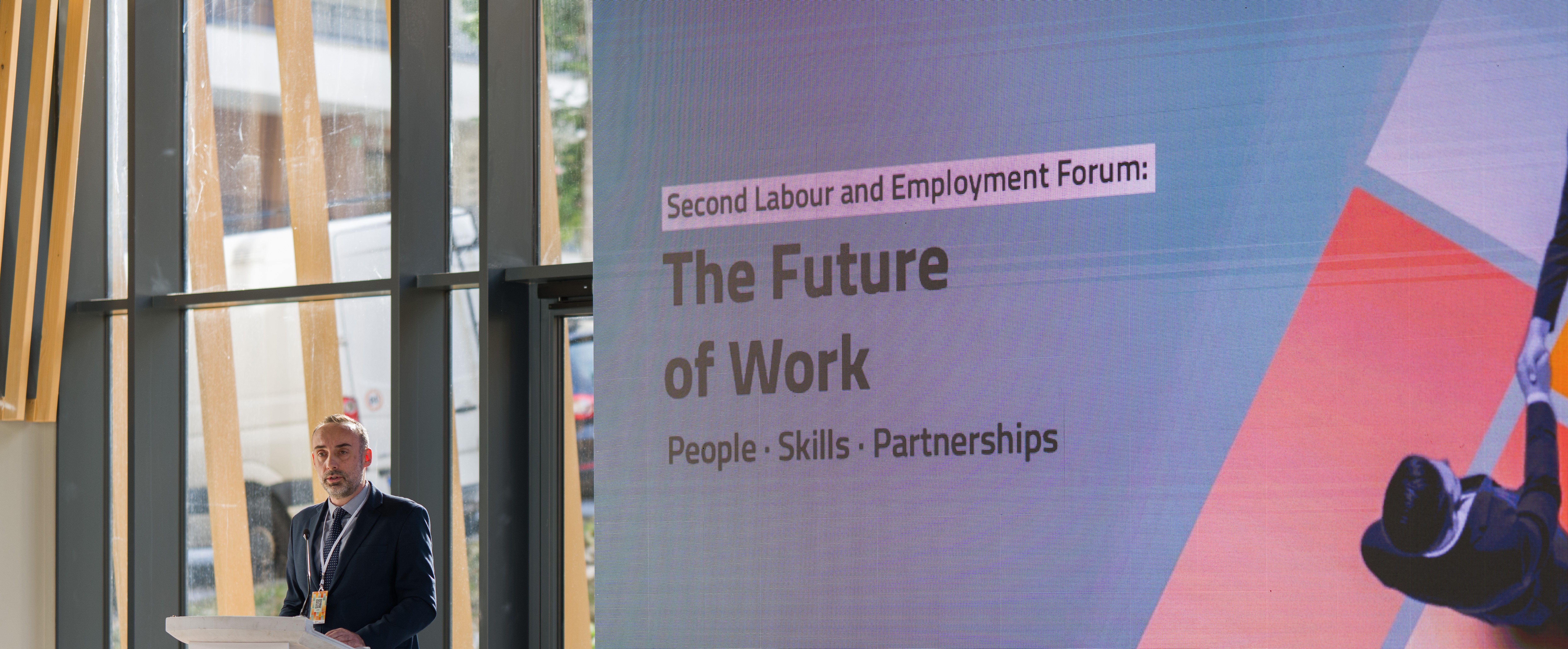
RCC ESAP 3: Sinisa Marcic, RCC’s Senior Expert on Human Capital Development delivering speech at Second Labour and Employment Forum, November 17-18, 2026 (Photo: courtesy of Labour and Employment Agency of Bosnia and Herzegovina)
RCC ESAP 3: Panel discussion at Second Labour and Employment Forum, November 17-18, 2026 (Photo: courtesy of Labour and Employment Agency of Bosnia and Herzegovina)
RCC ESAP 3: Second Labour and Employment Forum, November 17-18, 2026 (Photo: courtesy of Labour and Employment Agency of Bosnia and Herzegovina)
ESAP 3 project of the RCC supported the organisation of the second Labour and Employment Forum, organised by the Labour and Employment Agency (LEA) of Bosnia and Herzegovina
The Labour and Employment Forum, entitled “The Future of Work - People, Skills and Partnerships”, was held on 17–18 November 2026 on Bjelašnica, Bosnia and Herzegovina. The event was organised by the Labour and Employment Agency (LEA) of Bosnia and Herzegovina. The Employment and Social Affairs Platform (ESAP 3) project of the Regional Cooperation Council (RCC), through its Technical Assistance (TA) facility, provided organisational support.
Opening remarks were delivered by Ljiljana Jurak, from the Ministry of Civil Affairs of Bosnia and Herzegovina; David Womble, from the International Organization for Migration (IOM); Siniša Marčić, from the RCC; Magdalena Mueller-Uri, from the EU Delegation to Bosnia and Herzegovina, and Ivan Barbalić, from the LEA, Bosnia and Herzegovina.
In his welcome address, Siniša Marčić, RCC Senior Expert on Human Capital Development, highlighted the importance of human capital development in the evolving labour market across the Western Balkans Six (WB6). He underlined the RCC’s efforts in this area, including the most recent 2026 Public Employment Services (PES) Benchlearning exercise in the WB6, implemented by the ESAP 3 project, which aims to strengthen the organisational capacity, effectiveness and performance of public employment services across the region.
The Forum featured panel discussions addressing the impact of technology and artificial intelligence (AI) on the labour market, policies for building labour market resilience, labour migration and workforce mobility, including the role of the diaspora.
One of the panels, entitled “Smart Policies and Institutions for a More Resilient Labour Market” was hosted by the ESAP 3 project. It focused on partnerships and mutual learning, with particular emphasis on the PES Benchlearning exercise in the WB6, skills intelligencem, anticipating future skills needs, adult education, lifelong learning, and development of occupational and qualification standards.
Other two panels, “Technology, Innovation and New Tools for the Future of Work” and “Diaspora and Labour Migration as Drivers of Human Capital Development”, focused respectively on the role of public employment services in the era of artificial intelligence, featuring a practical example of the development and implementation of AI tools from Azerbaijan; and workforce mobility, its role in human capital development and the EU integration process as well as approaches to facilitating successful labour mobility and the contribution of the global diaspora to the future of the labour market.
The Forum brought together representatives of institutions at all levels of government, public employment services, trade unions, employers, academia and international stakeholders.