


News
16 November 2026 |News
Driving up productivity: Strengthening the voice of employers’ organizations in the Western Balkans
ILO: Driving Up Productivity: Regional Training for Employers and Business Membership Organizations in the Western Balkans
Why is closing the productivity gap with the EU proving so challenging for the Western Balkans? What holds back productivity across economies, sectors and enterprises? And how can employers’ organizations turn evidence into effective policy advocacy?
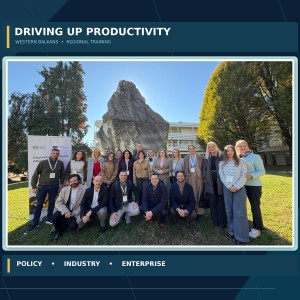
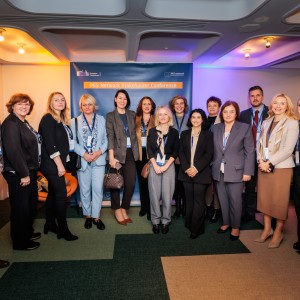
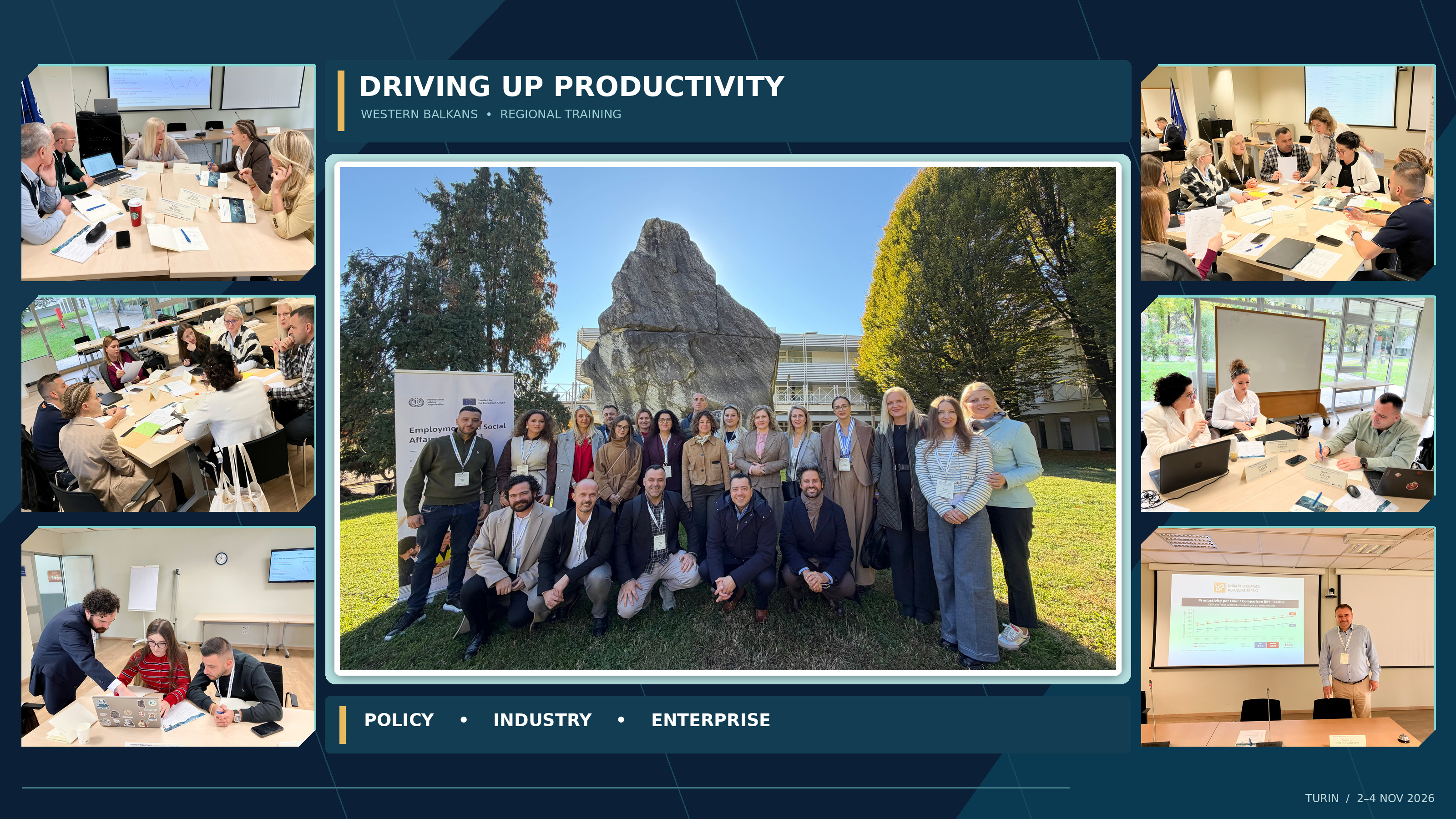
Turin, Italy, 2–4 November 2026 – These questions brought together 16 representatives of employers’ and business membership organizations (EBMOs), 11 women and 5 men, from across the Western Balkans for a regional training course organised by the ILO Bureau for Employers’ Activities (ACT/EMP) and the International Training Centre of the ILO (ITCILO), with support from the European Union (EU) funded Employment and Social Affairs Platform (ESAP) 3 project.
The three-day training explored productivity from three interconnected perspectives: the wider economy, sectors and individual enterprises. Participants examined what drives productivity, why figures sometimes tell different stories, and how employers’ organisations can use economic evidence to influence policies and support their members.
For the Western Balkans, improving productivity is essential to strengthening competitiveness, attracting investment, creating better jobs and narrowing the economic gap with the EU. Yet productivity growth across the region remains uneven.
Regional research illustrated these differences. While Serbia has made significant progress towards EU productivity levels, other economies have struggled to catch up. Evidence from Montenegro showed how an economy can expand through increased employment and investment without becoming more efficient. In North Macedonia, research revealed productivity differences approaching twentyfold between higher- and lower-performing firms in the same industry.
What explains these gaps?
Part of the answer lies in the business environment: access to finance, reliable infrastructure, predictable regulations, fair competition and relevant workforce skills. Sector-specific conditions also matter. Equally important is what happens inside enterprises, where management practices, technology adoption, innovation and the effective use of skills can make a substantial difference.
A striking example from North Macedonia showed how lengthy construction permit procedures forced one company to maintain warehouses in different locations, adding transport, coordination and operational costs. For an individual enterprise, such obstacles may be difficult to overcome. For an employers’ organisation, however, they provide an opportunity to document shared challenges and advocate for practical reforms.
The training also explored how artificial intelligence, digital technologies and changing market requirements are reshaping productivity. While new technologies offer significant opportunities, their benefits depend on enterprises having the skills, financing and management capabilities to use them effectively.
Turning evidence into action
Drawing on the experience of Confindustria, Italy’s leading employers’ organisation, participants examined how economic analysis can strengthen policy advocacy. Reliable data enable EBMOs to move beyond general demands for better business conditions and formulate specific, evidence-based reform proposals.
Employers’ organisations can also support productivity improvements directly through management training, benchmarking, skills partnerships, technology adoption and stronger connections between enterprises and international supply chains.
Participants applied these insights in a simulation exercise, developing a tripartite productivity improvement plan that brought together the responsibilities of governments, employers and workers. The exercise highlighted the importance of social dialogue in identifying priorities and translating policy proposals into practical action.
The programme was developed under the leadership of José Luis Viveros Añorve (ILO ACT/EMP HQ), together with Eduardo Martins and Jorge Ramírez (ITCILO Employers’ Programme), with contributions from Daniel Samaan (ILO Research Department), Ada Huibregtse (ESAP 3, ILO DWT/CO Budapest) and Iulia Drumea (ACT/EMP, ILO DWT/CO Budapest).
The training reinforced a central message: productivity gains require action at multiple levels, combining sound economic policies, stronger enterprise capabilities, innovation and cooperation.
Through ESAP 3, the ILO and the European Union continue to strengthen the capacity of employers’ organisations across the Western Balkans to contribute to evidence-based social dialogue and promote more productive, competitive and sustainable enterprises.
For more details see: https://lnkd.in/p/giyS7RH5
Participating Organizations:
BiznesAlbania https://www.facebook.com/biznes.albania.1
Union of Employers of Republika Srpska https://www.facebook.com/rsposlodavci
Montenegrin Employers Federation https://www.facebook.com/UnijaPoslodavacaCG/
Organization of Employers of Macedonia https://www.facebook.com/profile.php?id=100054392026258
Kosovo Business Alliance https://www.facebook.com/people/Aleanca-Kosovare-e-Bizneseve/100058047594943/
Association of Fruit and Vegetable Processors of Kosovo https://www.facebook.com/PemePerimeTeKosoves