


News
11 November 2025 |News
ILO ESAP 3: ILO supports Macedonian Employers’ Organization to strengthen evidence-based social dialogue through productivity research
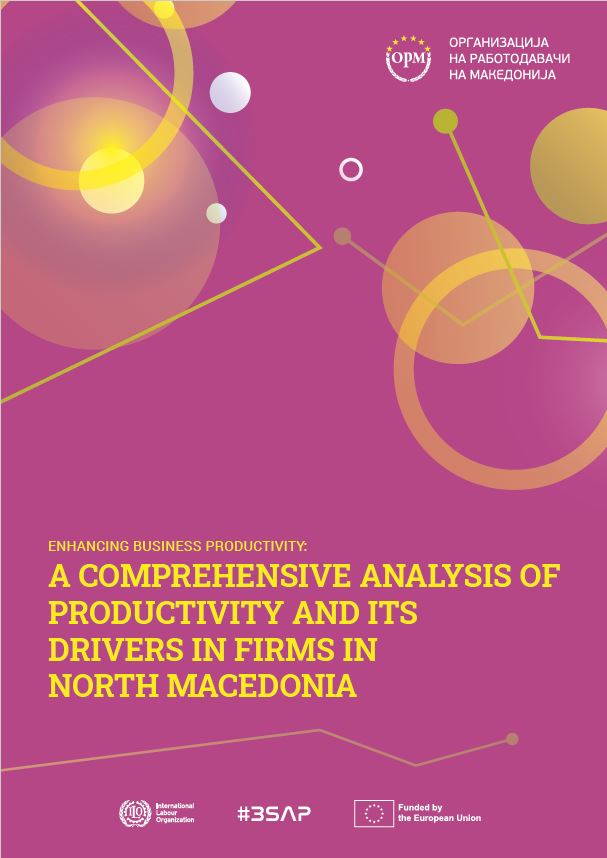
©ILO: Enhancing Business Productivity: A Comprehensive Analysis of Productivity and Its Drivers in Firms in North Macedonia
Through the EU-funded Employment and Social Affairs Platform (ESAP) 3 project in the Western Balkans, the International Labour Organization (ILO) supported the Organization of Employers of Macedonia (EOM) in developing the research paper Enhancing Business Productivity: A Comprehensive Analysis of Productivity and Its Drivers in Firms in North Macedonia Enhancing Business Productivity: A Comprehensive Analysis of Productivity and Its Drivers in Firms in North Macedonia. The study, owned by EOM and supported by ESAP 3, reflects a joint effort to strengthen the analytical capacity of employers’ organizations and equip them with evidence that can inform dialogue on economic reform and private sector development.
The paper examines productivity in North Macedonia through the lens of total factor productivity (TFP), offering a broader view than traditional labour productivity by looking at how firms combine labour and capital and how efficiently they use both. Its findings point to a worrying decline in firm productivity over time. Between 2013 and 2019, the TFP of the average firm declined by 8.4 per cent, suggesting worsening efficiency in the use of production factors. The analysis also reveals wide disparities across firms, with the most productive firms being up to 14 times more efficient than the least productive ones. This signals structural inefficiencies in the allocation of labour, capital and technology across the economy.
The study further shows that firms with foreign ownership perform significantly better, with productivity levels about four times higher than domestically owned firms, while export-oriented firms also outperform those serving only the domestic market. At the same time, the research identifies corruption and financial constraints as the strongest barriers to productivity growth, far outweighing other factors. Infrastructure matters as well, especially transport, energy reliability and local permit systems, while burdensome regulation and unfair competition also weigh on business performance.
Beyond the findings themselves, this cooperation demonstrates the value of investing in the capacities of employers’ organizations. By supporting EOM to commission and use solid research, the ILO is helping strengthen its ability to contribute to social dialogue with concrete evidence, practical recommendations and a stronger policy voice. This enables EOM to engage not only from the perspective of business representation, but also as a credible knowledge partner in discussions on competitiveness, productivity, investment climate and reform priorities.
Such evidence-based engagement adds value to social dialogue. It helps shift discussions from general positions to concrete policy issues, supports more informed exchanges with government and workers’ representatives, and provides knowledge that can be used by all actors influencing economic policy. In that sense, the research paper is not only an analytical product, but also a practical tool for better dialogue and better policymaking in North Macedonia and the wider Western Balkans region.